Managing a small business comes with a steep learning curve. Over the past nine years working in commercial insurance advisory and corporate employee benefits, I have sat down with hundreds of small business owners. The story is almost always the same: you want to take care of your core team, keep retention high, and recruit top-tier talent, but the moment you open a standard health insurance quote, the numbers look completely unsustainable.
Health benefit costs have climbed steadily year after year. For a lean startup or a growing 15-person company, offering group medical coverage can feel like taking on a second mortgage.
However, skipping health benefits altogether is rarely a viable option anymore. Employees prioritize comprehensive healthcare above almost every other perk, including raw salary bumps.
The good news? The group benefits landscape has evolved significantly. You no longer have to settle for rigid, traditional group health policies that eat away your entire profit margin.
Below is an honest, field-tested breakdown of the 7 most affordable small business employee health insurance plans available today, along with practical advice on how to structure them without overspending.
What Actually Makes a Small Business Health Plan “Affordable”?
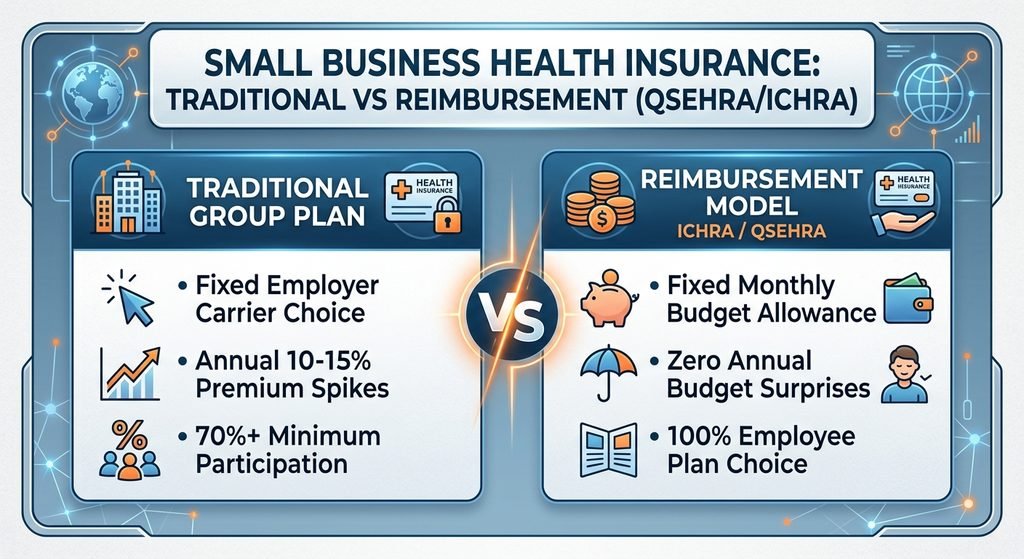
When business owners ask me for an “affordable” policy, I always clarify one thing first: affordability is not just about the monthly premium.
A plan with a low premium might carry a $10,000 deductible, rendering it virtually useless for your employees’ day-to-day healthcare needs. Conversely, a plan with slightly higher monthly dues might save you thousands through tax deductions and employee cost-sharing.
When evaluating employee health plans, I look at four key factors:
- Employer Contribution Control: Can you lock in a fixed monthly budget, or are you at the mercy of sudden annual premium hikes?
- Tax Advantages: Does the structure reduce your payroll taxes (FICA) or qualify for federal tax credits?
- Network Flexibility: Are your workers forced into narrow local networks, or do they have broad access to doctors and specialists?
- Administrative Overhead: Will managing this policy require a full-time HR manager, or can you run it smoothly in 15 minutes a month?
Top 7 Affordable Small Business Employee Health Insurance Plans
+------------------------------------+--------------------------+-------------------------------------+
| Health Insurance Plan Type         | Best Suited For          | Primary Benefit / Advantage         |
+------------------------------------+--------------------------+-------------------------------------+
| 1. QSEHRA (Reimbursement)          | Under 50 Employees       | Fixed budget, zero premium spikes   |
| 2. ICHRA (Individual Coverage)     | Diverse Workforce        | Flexible tiers & custom budgets     |
| 3. Small Group PPO / HMO Plans     | Established Teams (5-50) | Classic benefits, tax-deductible    |
| 4. Level-Funded Plans              | Healthy, Tech-Forward    | Refund on unused claims fund        |
| 5. SHOP Marketplace Plans          | Low-Average Wage Teams   | Up to 50% Small Business Tax Credit |
| 6. PEO Health Plans                | Rapidly Scaling Teams    | Enterprise rates via pooled buying  |
| 7. Association Health Plans (AHPs) | Niche Industry/Trade     | Group buying power across companies |
+------------------------------------+--------------------------+-------------------------------------+
1. QSEHRA (Qualified Small Employer Health Reimbursement Arrangement)
If you employ fewer than 50 full-time equivalent (FTE) workers and want zero surprises in your annual budget, a QSEHRA is often the single best starting point.
How It Works
Instead of buying a traditional group plan from an insurer, you set a tax-free monthly allowance (for example, $300/month per employee). Your workers buy their own individual health plans on the ACA Marketplace or directly from providers. They submit proof of their premium or medical expenses, and you reimburse them up to your chosen limit.
Key Advantages
- 100% Tax-Deductible: Employer reimbursements are tax-deductible for the business and tax-free for the employee.
- No Minimum Participation Rules: Traditional plans require 70% or more of your staff to enroll. QSEHRAs have no minimum participation requirements.
- Predictable Overhead: Your business cost stays exactly where you set it. No unexpected 15% rate increases next year.
When to Be Careful
Reimbursement limits are capped annually by federal regulations, so you cannot arbitrarily fund unlimited amounts under a QSEHRA.
2. ICHRA (Individual Coverage Health Reimbursement Arrangement)
Consider ICHRA as the flexible, scalable big brother to the QSEHRA. Introduced relatively recently, it has quickly become one of my favorite recommendations for mid-sized growing teams.
How It Works
Like a QSEHRA, ICHRA relies on reimbursement rather than purchasing a pre-selected group plan. However, ICHRA has no business size limits and no monthly allowance caps.
Crucially, ICHRA allows you to create different employee classes. For example, you can offer a $500/month allowance for full-time executive staff, $350/month for regular full-time staff, and $200/month for hourly workers.
Key Advantages
- Custom Customization: Classify allowances by location, employment status (full-time vs. part-time), or role.
- Employee Choice: Employees pick the individual policy that fits their family doctor preferences and health history.
- Scalability: It works equally well whether you have 4 employees or 400.
When to Be Careful
Employees must be enrolled in a qualified Individual ACA plan (Qualified Health Plan) to receive tax-free reimbursements.
3. Traditional Small Group Health Plans (HMO & PPO)
Traditional group health insurance is still the standard benchmark in many industries. You select one or two plan options from a carrier (like Blue Cross Blue Shield, UnitedHealthcare, or Aetna), and both you and the employee split the premium cost.
Option Breakdown: HMO vs. PPO
- HMO (Health Maintenance Organization): Highly affordable monthly premiums, but employees must select a Primary Care Physician (PCP) and stay within a localized network. Out-of-network care is generally not covered.
- PPO (Preferred Provider Organization): Higher monthly premiums, but provides out-of-network coverage and allows employees to visit specialists without a doctor’s referral.
Key Advantages
- Familiarity: Most workers already understand how traditional group insurance cards work.
- Pre-Tax Payroll Deductions: Employee premium contributions are deducted before taxes via a Section 125 Cafeteria plan, reducing your payroll tax liabilities.
When to Be Careful
Watch out for strict participation rates. Most carriers mandate that at least 70% to 75% of your eligible employees enroll in the plan.
4. Level-Funded Health Plans
Level-funded plans bridge the gap between traditional fully-insured plans and self-insured plans. Over my years advising small firms, level-funded options have consistently offered the highest savings for relatively healthy, young teams.
How It Works
Your monthly payment is fixed (“level”) for the entire year, just like a traditional plan. This payment is split into three buckets:
- Administrative costs
- Stop-loss insurance (protection against catastrophic claims)
- A claims fund to pay your team’s medical bills
Key Advantages
- Surplus Refunds: If your employees file fewer medical claims than expected throughout the year, you receive a partial refund or credit toward next year’s premiums.
- Lower Premium Taxes: Because these plans operate under self-insurance guidelines, they avoid many state-level premium taxes.
When to Be Careful
If your team experiences high or chronic medical claims throughout the year, you won’t get a refund, and your renewal rate can jump significantly for the following term.
5. SHOP Marketplace Plans (Small Business Health Options Program)
Run through federal or state healthcare exchanges, SHOP is designed specifically for small employers with 1 to 50 employees.
How It Works
You access your state’s healthcare portal, select a tier of coverage (Bronze, Silver, Gold, or Platinum), and decide how much you want to contribute toward employee premiums.
Key Advantages: The Small Business Health Care Tax Credit
This is SHOP’s single biggest selling point. If you meet three specific criteria, you may qualify for a tax credit worth up to 50% of your contributed premium costs:
- You have fewer than 25 full-time equivalent employees.
- The average annual salary across your company is below a specific inflation-adjusted threshold (around $56,000–$60,000).
- You pay at least 50% of your full-time employees’ premium costs.
When to Be Careful
Plan choices on the SHOP exchange can be somewhat limited depending on your county or state.
6. PEO (Professional Employer Organization) Health Plans
Joining a PEO is a co-employment arrangement where you outsource HR, payroll, and benefits administration to a larger firm.
How It Works
Because a PEO pools thousands of small business employees into one massive buying group, they can negotiate enterprise-level health insurance rates with major carriers like Aetna or Cigna.
Key Advantages
- Fortune 500 Level Benefits: Access to top-tier health plans, dental, vision, and wellness programs that a 10-person business could never afford independently.
- HR Automation: The PEO handles payroll deductions, compliance paperwork, and COBRA administration.
When to Be Careful
PEOs charge per-employee monthly administrative fees. You need to calculate whether the health insurance savings outweigh the administrative costs.
7. Association Health Plans (AHPs)
An Association Health Plan allows small businesses in similar industries, chambers of commerce, or trade organizations to band together and buy insurance collectively.
How It Works
By uniting under a single industry umbrella (e.g., regional contractors, tech alliances, or restaurant associations), the group gains the purchasing leverage of a large corporation.
Key Advantages
- Tailored Industry Benefits: Plans are tailored to the specific risk profiles and needs of your industry sector.
- Lower Administrative Expenses: Spreading overhead across hundreds of businesses reduces per-policy costs.
When to Be Careful
State regulations surrounding AHPs vary significantly. Make sure the association you join works with reputable, fully backed carriers.
4 Cost-Saving Strategies Every Small Employer Should Use
Regardless of which health plan structure you select, these four strategies will help keep your healthcare expenses under control:
1. Pair High Deductible Plans (HDHPs) with an HSA
High Deductible Health Plans offer substantially lower monthly premiums. Pairing an HDHP with a Health Savings Account (HSA) allows employees to contribute tax-free dollars to pay for qualified out-of-pocket medical bills. Employers can also make small tax-deductible contributions to employee HSAs as a perk.
2. Implement a Section 125 POP (Premium Only Plan)
Setting up a Section 125 plan allows employees to pay their portion of health insurance premiums using pre-tax income. This reduces their taxable salary, which directly lowers your company’s matching FICA tax contributions (7.65%).
3. Offer Virtual Care / Telehealth Services
Adding low-cost telehealth subscriptions (like Teladoc) costs only a few dollars per employee each month. Encouraging virtual visits for routine issues cuts down on expensive urgent care visits and keeps overall claims lower.
4. Re-evaluate Your Census Annually
Never let a group health plan auto-renew without reviewing your numbers. Changes in team demographics, average age, or location can dramatically shift which plan type makes the most financial sense from one year to the next.
Final Verdict: How to Choose the Right Plan for Your Team
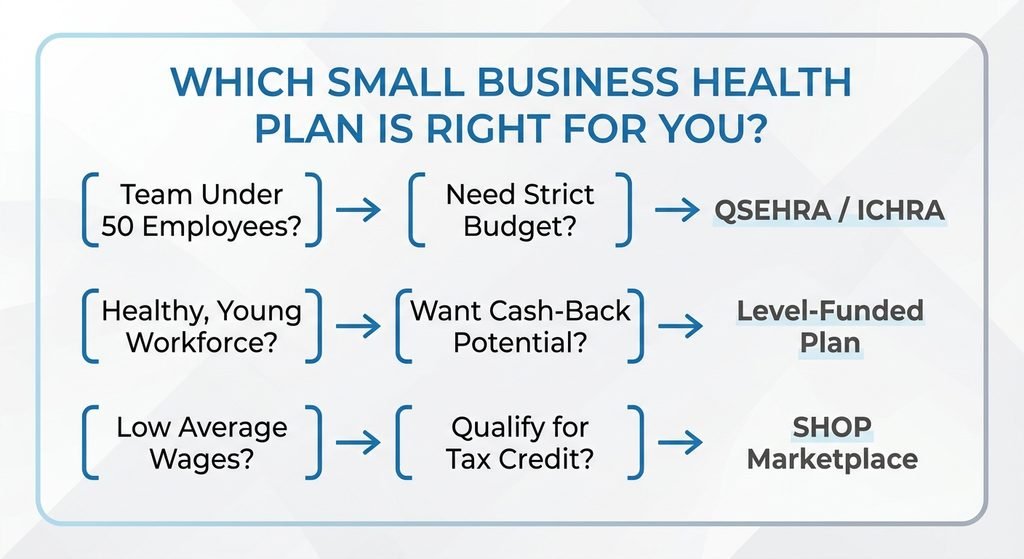
Selecting an employee health plan isn’t about finding a one-size-fits-all solution; it’s about matching your business’s current stage with the right financial model:
- For startups and businesses under 10 employees wanting maximum financial predictability: Go with a QSEHRA.
- For growing teams with diverse salary levels and locations: Choose an ICHRA.
- For healthy, stable teams looking for cash-back potential: Look into a Level-Funded Plan.
- For low-wage small businesses qualifying for government incentives: Leverage the SHOP Marketplace Tax Credit.
Take the time to evaluate your payroll numbers, survey your staff on their healthcare needs, and consult with an independent licensed benefits broker who can pull competitive market quotes for your specific region.